

The room where the workshop took place had pointillist paintings on the walls. I didn’t choose the venue for the metaphor, but the metaphor chose itself.
Pointillism works like this: hundreds of discrete dots of colour, each meaningless in isolation, cohere into a landscape only when viewed from the right distance. Stand too close and you see pigment on canvas — texture without meaning. Step back to the right vantage point and a harbour appears, boats catch light, water moves. The image was always there. What changed was the position of the observer.
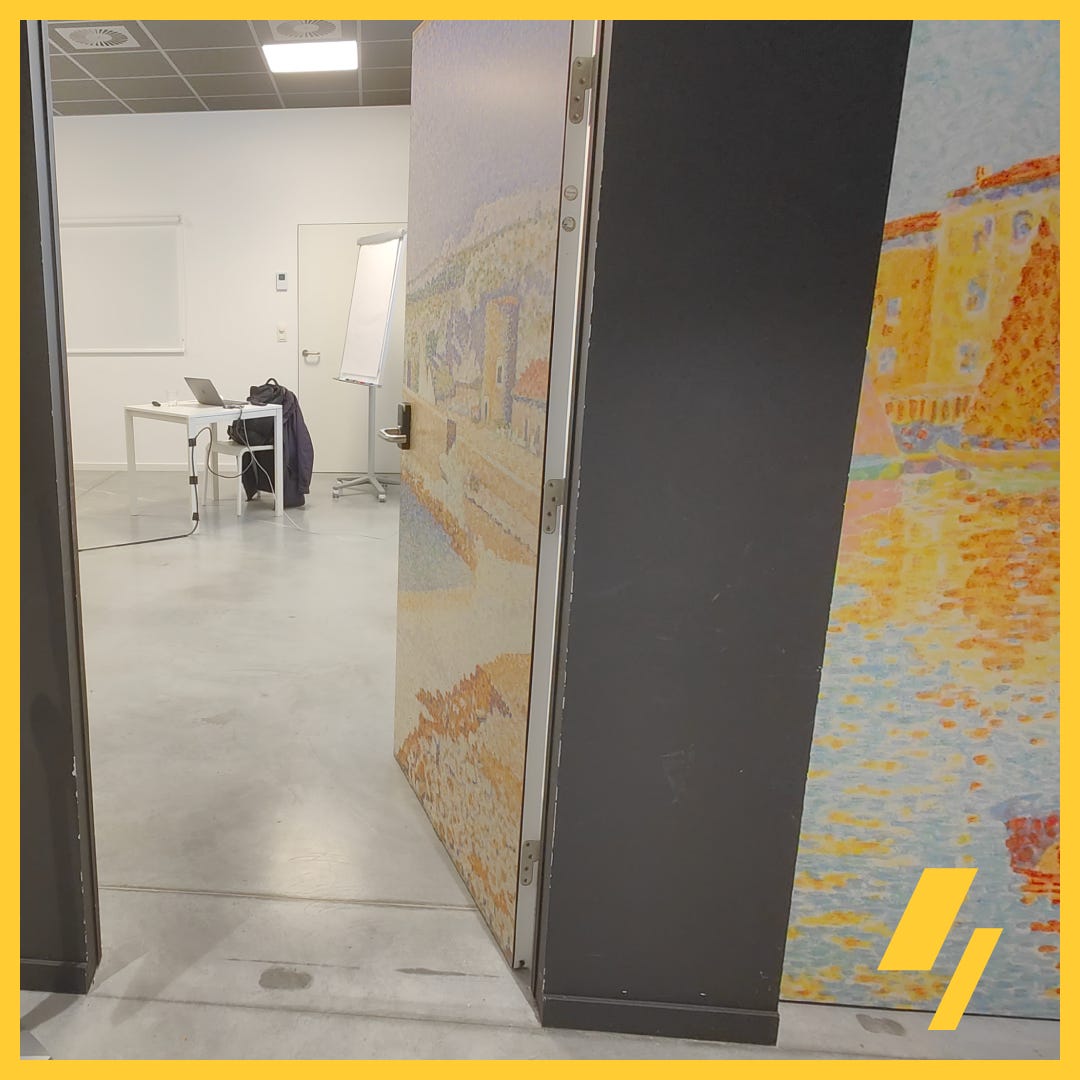
This is the problem most organisations have with their own reality. Not that they lack information – they are drowning in it. Not that they lack talented people – the room is full of them. The problem is proximity. When you are inside the daily operations of a business, you see your dots with extraordinary clarity. You know your function, your challenges, your immediate pressures. What you cannot see – what proximity makes structurally invisible – is how your dots relate to everyone else’s. The painting is there. You are literally too close to see it. In fact you are immersed in it. Maybe you are also one of the dots…
The picture is a snapshot from a workshop that brought together key stakeholders of a business to work on what had initially been framed as “real growth.” Within the first segment, we reframed the question together. Growth – understood narrowly as more revenue through the same logic – was not the challenge. Development was. How does an organisation, with a keen understanding of itself as a collective and a genuine desire of its owners to make it participative for its key stakeholders, actually develop its capacity to act coherently? How does it grow without losing what makes it work?
These are not simple questions. They resist simplification. They involve dimensions that don’t reduce neatly to a matrix or a scorecard: culture, identity, relationships between units, the informal channels through which real decisions actually flow, the tensions that are productive and the ones that aren’t. Any framework that promises to compress this into a tidy deliverable is not clarifying the picture. It is replacing it with a different, simpler picture that happens to be easier to present. And oftentimes doing poorly against the complex reality it is supposed to represent.
The contribution is distance and the ability to ask the right questions fast enough for them to enable an opening in perception.
The work I find most valuable moves in the opposite direction. Not simplification but sense-making. Holding the complexity the client actually faces, working with all its dimensions, and helping the people in the room build their own representation of their reality – one they recognise, contest, refine, and ultimately own. The output is not a borrowed framework with the client’s logo on it. It is a shared map that the people who built it can actually navigate by, because they know where the terrain was contested, where the assumptions sit, where the unknowns remain. It is individual, team-level, functional, cross-functional, collective analytical and integral comprehension of the situation of the business. Something that should never be outsourced to consultants or AI tools, but which only emerges when an organization can be guided by a trusted partners who will walk miles together with its people sharing the same conditions and constraints as them before formulating easy “recommendations”.
This is where the external eye matters – and where its value is most often misunderstood. The facilitator’s contribution is not superior knowledge of the client’s business. The people in the room will always know more about their own reality than any outsider. The contribution is distance and the ability to ask the right questions fast enough for them to enable an opening in perception. The external eye provides the vantage point from which the dots begin to cohere. It sees connections between what the commercial team knows and what operations experiences, between what the founders intend and what the organisation has actually become, between the story the company tells itself and the story the numbers tell. Not because the outsider is smarter, but because the outsider is not embedded in any single cluster of dots. The outsider can move between them.
Good facilitation makes this movement productive. It creates the conditions for people who hold different fragments of the truth to lay them out, compare them, argue about them, and arrive at a representation that is richer than any individual perspective. It is not about alignment in the corporate sense – that anaemic word that usually means everyone agrees to stop disagreeing. It is about the construction of shared situational awareness: a common understanding of where the organisation actually is, what it actually faces, and what options actually exist. Awareness that is shared not because it was imposed, but because it was built together.
This requires time. And not just any time – time away from the daily environment, the operational rhythm, the inbox, the next meeting. There is a reason the workshop happens in a room that is not the office. The daily environment has its own gravity. It pulls attention toward the urgent, the immediate, the already-framed. Stepping out of that environment is not a luxury. It is the condition for a different kind of attention — the kind that can hold multiple dimensions simultaneously, that can sit with uncertainty long enough for something genuine to emerge, that can think about the organisation’s future on its own terms rather than in reaction to whatever is on fire this week.
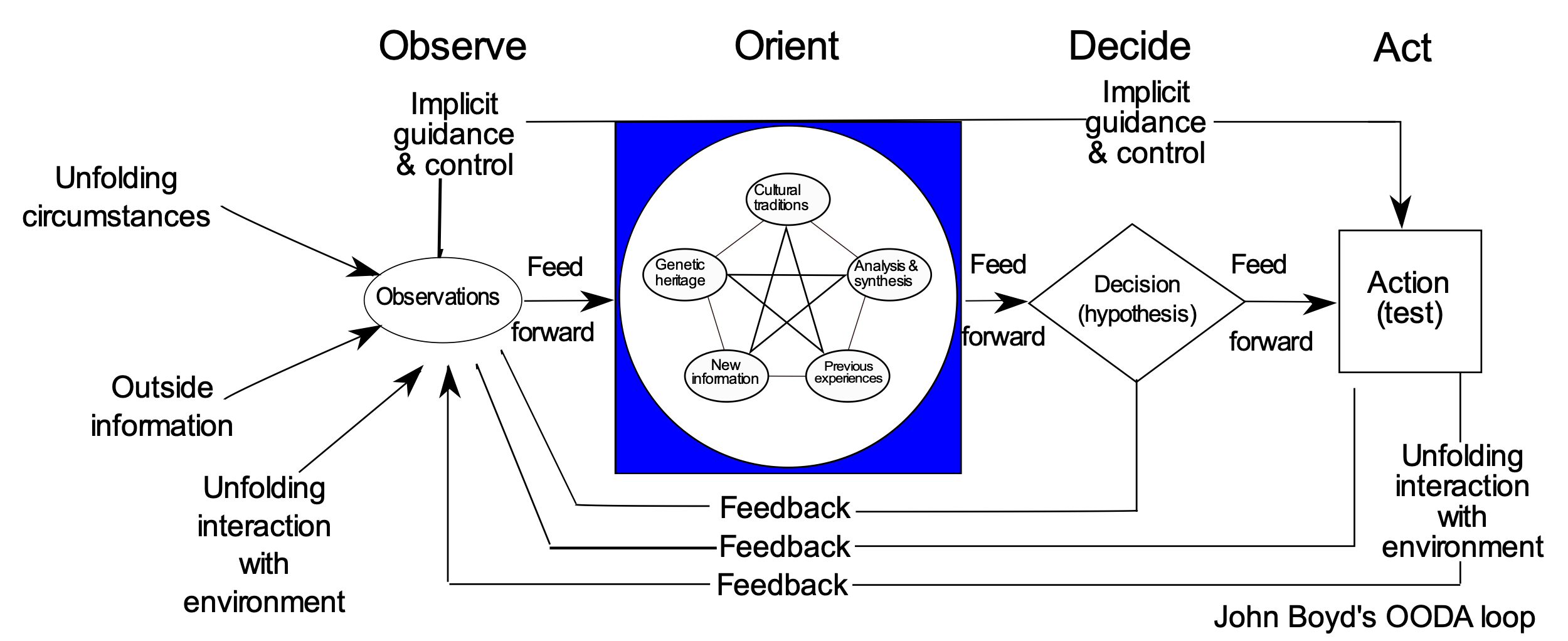
John Boyd, the strategist who gave us the OODA framework – observe, orient, decide, act – understood that the most critical and most neglected phase is orientation. Orientation is where raw observation becomes situational awareness. It’s where you build the representation of reality that all subsequent decisions depend on. Boyd was explicit that in complex environments, orientation requires the confrontation of multiple perspectives, each holding partial truth. It requires active construction of a common frame – not consensus imposed from above, but a map that participants have stress-tested against their own knowledge and experience.
A tailored workshop with the right stakeholders, working on the real strategic questions, is orientation made operational.
The dots on those canvases were placed by a human hand that understood colour theory, light, and the physiology of perception. Each dot was a decision. The painting emerged not from the dots alone but from the intelligence that arranged them – from someone who could see how the parts would compose into a whole that none of them could be individually.
Every organisation contains the dots of its own future. The question is whether anyone has created the conditions – the right distance, the right room, the right confrontation of perspectives – for the picture to emerge. Not someone else’s picture, imported and labelled. Your own.